"A Year In Provence" - читать интересную книгу автора (Mayle Peter)
March
 |
THE ALMOND TREE was in tentative blossom. The days were longer, often ending with magnificent evenings of corrugated pink skies. The hunting season was over, with hounds and guns put away for six months. The vineyards were busy again as the well-organized farmers treated their vines and their more lackadaisical neighbors hurried to do the pruning they should have done in November. The people of Provence greeted spring with uncharacteristic briskness, as if nature had given everyone an injection of sap.
The markets changed abruptly. On the stalls, fishing tackle and ammunition belts and waterproof boots and long brushes with steel bristles for amateur chimney sweeps were replaced by displays of ferocious-looking agricultural implements-machetes and grubbing tools, scythes and hoes with sharp curved prongs, spraying equipment that was guaranteed to bring the rain of death down on any weed or insect foolhardy enough to threaten the grapes. Flowers and plants and tiny new season vegetables were everywhere, and café tables and chairs sprouted on the pavements. There was a feeling of activity and purpose in the air, and one or two optimists were already buying espadrilles from the multicolored racks outside the shoe shops.
In contrast to this bustle, work on the house had come to a standstill. Following some primeval springtime urge, the builders had migrated, leaving us with some token sacks of plaster and piles of sand as proof of their intention to come back-one day-and finish what they had so nearly finished. The phenomenon of the vanishing builder is well known throughout the world, but in Provence the problem has its own local refinements and frustrations, and its own clearly defined seasons.
Three times a year, at Easter, August, and Christmas, the owners of holiday homes escape from Paris and Zürich and Düsseldorf and London to come down for a few days or weeks of the simple country life. Invariably, before they come, they think of something that is crucial to the success of their holiday: a set of Courrèges bidets, a searchlight in the swimming pool, a retiled terrace, a new roof for the servants' quarters. How can they possibly enjoy their rustic interlude without these essentials? In panic, they telephone the local builders and craftsmen. Get it done-it
It is too tempting to ignore. Everyone remembers when Mitterrand first came to power; the rich went into financial paralysis, and sat on their cash. Building work was scarce in Provence then, and who knows when bad times might come again? So the jobs are accepted, and less clamorous clients suddenly find themselves with dormant concrete mixers and forlorn, uncompleted rooms.
Faced with this situation, there are two ways to respond. Neither of them will produce immediate results, but one way will reduce the frustration, and the other will add to it.
We tried both. To begin with, we made a conscious effort to become more philosophical in our attitude to time, to treat days and weeks of delays in the Provençal fashion-that is, to enjoy the sunshine and to stop thinking like city people. This month, next month, what's the difference? Have a pastis and relax. It worked well enough for a week or two, and then we noticed that the building materials at the back of the house were turning green with the first growth of spring weeds. We decided to change our tactics and get some firm dates out of our small and elusive team of workmen. It was an educational experience.
We learned that time in Provence is a very elastic commodity, even when it is described in clear and specific terms.
But, despite their genial contempt for punctuality and their absolute refusal to use the telephone to say when they were coming or when they weren't, we could never stay irritated with them for long. They were always disarmingly cheerful, they worked long and hard when they were with us, and their work was excellent. In the end, they were worth waiting for. And so, little by little, we reverted to being philosophical, and came to terms with the Provençal clock. From now on, we told ourselves, we would assume that nothing would be done when we expected it to be done; the fact that it happened at all would be enough.
FAUSTIN was behaving curiously. For two or three days he had been clanking up and down on his tractor, towing a contraption of metal intestines which spewed fertilizer to either side as he passed between the rows of vines. He kept stopping to get off the tractor and walk over to a field, now empty and overgrown, which had been planted with melons. He studied the field from one end, remounted his tractor, sprayed some more vines, and returned to study the other end. He paced, he pondered, he scratched his head. When he went home for lunch, I walked down to see what it was he found so fascinating, but to me it looked like any other fallow melon field-a few weeds, some tatters of plastic left over from the strips that had protected last year's crop, half an acre of nothing. I wondered if Faustin suspected it of harboring buried treasure, because we had already dug up two gold Napoleon coins nearer the house, and he had told us that there were probably more to be found. But peasants don't hide their gold in the middle of cultivated land when it can be squirreled away more securely under the flagstones or down a well. It was odd.
He came visiting that evening with Henriette, looking unusually spruce and businesslike in his white shoes and orange shirt, and bearing jars of homemade rabbit pâté. Halfway through his first pastis, he leaned forward confidentially. Did we know that the wine produced from our vineyards-Côtes du Lubéron-was about to be given
There was no arguing with that, so Faustin moved on to a second drink-he drank in an efficient, unobtrusive way, and always reached the bottom of his glass before I expected-and put forward his proposition. It seemed to him that our melon field could be more profitably employed. He inhaled some pastis while Henriette produced a document from her bag. It was a
By chance, he said, he had made some calculations. Our field would accommodate 1,300 new vines in place of the tiresome melons. My wife and I looked at each other. We were equally fond of wine and Faustin, and he obviously had his heart set on progress and expansion. We agreed that the extra vines sounded like a good idea, but thought no more about it after he had left. Faustin is a ruminant among men, not given to hasty action, and in any case, nothing happens quickly in Provence. Perhaps next spring he would get around to it.
At seven o'clock the following morning, a tractor was plowing up the melon field, and two days later the planting team arrived-five men, two women, and four dogs, under the direction of the
The new vines, about the size of my thumb and tipped with red wax, were unloaded from the vans while Monsieur Beauchier inspected his planting equipment. I had assumed that the planting would be done mechanically, but all I could see were a few hollow steel rods and a large triangle made of wood. The planting team gathered around and were assigned their duties, then jostled untidily into formation.
Beauchier led the way with the wooden triangle, which he used like a three-sided wheel, the points making equidistant marks in the earth. Two men followed him with steel rods, plunging them into the marks to make holes for the vines, which were planted and firmed in by the rear guard. The two women, Faustin's wife and daughter, dispensed vines, advice, and fashion comments on the assortment of hats worn by the men, particularly Faustin's new and slightly rakish yachting cap. The dogs enjoyed themselves by getting in everyone's way, dodging kicks and tangling themselves in the twine.
As the day wore on, the planters became more widely spaced, with Beauchier often two hundred yards in front of the stragglers at the back, but distance was no barrier to conversation. It appears to be part of the ritual that lengthy discussions are always conducted between the two people farthest away from each other, while the intervening members of the team curse the dogs and argue about the straightness of the lines. And so the raucous procession moved up and down the field until mid-afternoon, when Henriette produced two large baskets and work stopped for the Provençal version of a coffee break.
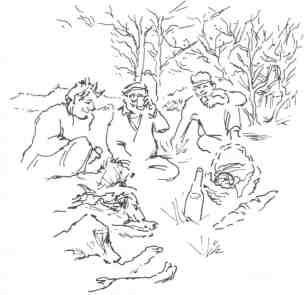
The team sat on a grassy bank above the vines, looking like a scene from Cartier-Bresson's scrapbook, and attacked the contents of the baskets. There were four liters of wine and an enormous pile of the sugared slices of fried bread called
The wine had all gone. The men stretched and brushed the crumbs from their mouths and went back to work. By late evening it was finished, and the ragged old melon field was now impeccable, the tiny dots of new vines just visible against the setting sun. The team gathered in our courtyard to unkink their backs and make inroads on the pastis, and I took Faustin to one side to ask him about payment. We'd had the tractor for three days, and dozens of hours of labor. What did we owe them? Faustin was so anxious to explain that he put down his glass. We would pay for the vines, he said, but the rest was taken care of by the system which operated in the valley, with everyone contributing their time free when major replanting had to be done. It all evened out in the end, he said, and it avoided paperwork and tedious dealings with
THE LUBÉRON sounded different in spring. Birds who had been ducking all winter came out of hiding now that the hunters were gone, and their song replaced gunfire. The only jarring noise I could hear as I walked along the path toward the Massot residence was a furious hammering, and I wondered if he had decided to put up a For Sale notice in preparation for the beginning of the tourist season.
I found him on the track beyond his house, contemplating a five-foot stake that he had planted at the edge of a clearing. A rusty piece of tin had been nailed to the top of the stake, with a single angry word daubed in white paint: PRIVÉ! Three more stakes and notices were lying on the track, together with a pile of boulders. Massot was obviously intending to barricade the clearing. He grunted good morning and picked up another stake, hammering it into the ground as if it had just insulted his mother.
I asked him what he was doing.
"Keeping out the Germans," he said, and started to roll boulders into a rough cordon between the stakes.
The piece of land that he was sealing off was some distance from his house, and on the forest side of the track. It couldn't possibly belong to him, and I said I thought it was part of the national park.
"That's right," he said, "but I'm French. So it's more mine than the Germans." He moved another boulder. "Every summer they come here and put up their tents and make
He straightened up and lit a cigarette, tossing the empty packet into the bushes. I asked him if he had thought that maybe one of the Germans might buy his house.
"Germans with tents don't buy anything except bread," he said with a sniff of disdain. "You should see their cars-stuffed with German sausage, German beer, tins of sauerkraut. They bring it all with them. Mean? They're real
Massot, in his new role as protector of the countryside and authority on the economics of tourism, went on to explain the problem of the peasant in Provence. He admitted that tourists-even German tourists-brought money to the area, and that people who bought houses provided work for local builders. But look what they had done to property prices! It was a scandal. No farmer could afford to pay them. We tactfully avoided any discussion of Massot's own attempts at property speculation, and he sighed at the injustice of it all. Then he cheered up, and told me a house-buying story that had ended to his complete satisfaction.
There was a peasant who for years had coveted his neighbor's house; not for the house itself, which was almost a ruin, but for the land that was attached to it. He offered to buy the property, but his neighbor, taking advantage of the sharp rise in house prices, accepted a higher offer from a Parisian.
During the winter, the Parisian spent millions of francs renovating the house and installing a swimming pool. Finally, the work is finished, and the Parisian and his chic friends come down for the long First of May weekend. They are charmed by the house and amused by the quaint old peasant who lives next door, particularly by his habit of going to bed at eight o'clock.
The Parisian household is awakened at four in the morning by Charlemagne, the peasant's large and noisy cockerel, who crows nonstop for two hours. The Parisian complains to the peasant. The peasant shrugs. It is the country. Cocks must crow. That is normal.
The next morning, and the morning after that, Charlemagne is up and crowing at four o'clock. Tempers are getting frayed, and the guests return to Paris early, to catch up on their sleep. The Parisian complains again to the peasant, and again the peasant shrugs. They part on hostile terms.
In August, the Parisian returns with a houseful of guests. Charlemagne wakes them punctually every morning at four. Attempts at afternoon naps are foiled by the peasant, who is doing some work on his house with a jackhammer and a loud concrete mixer. The Parisian insists that the peasant silence his cockerel. The peasant refuses. After several heated exchanges, the Parisian takes the peasant to court, seeking an injunction to restrain Charlemagne. The verdict is in favor of the peasant, and the cockerel continues his early morning serenades.
Visits to the house eventually become so intolerable that the Parisian puts it up for sale. The peasant, acting through a friend, manages to buy most of the land.
The Sunday after the purchase goes through, the peasant and his friend celebrate with a huge lunch, the main course of which is Charlemagne, turned into a delicious
Massot thought that this was a fine story-defeat for the Parisian, victory and more land for the peasant, a good lunch-it had everything. I asked him if it was true, and he looked at me sideways, sucking on the ragged end of his moustache. "It doesn't do to cross a peasant" was all he would say, and I thought that if I were a German camper I'd try Spain this summer.
EVERY DAY, as the weather stayed mild, there was fresh evidence of growth and greenery, and one of the most verdant patches of all was the swimming pool, which had turned a bilious emerald in the sunshine. It was time to call Bernard the
A job like this is never done in Provence simply on the basis of a phone call and a verbal explanation. There has to be a preliminary visit of inspection-to walk around the problem, to nod knowingly, to have a drink or two, and then to make another rendezvous. It is a kind of limbering-up exercise, only to be skipped in cases of real emergency.
On the evening Bernard arrived to look at the pool, I was scrubbing at the garland of green fur that had developed just above the water line, and he watched me for a few moments before squatting down on his haunches and wagging a finger under my nose. Somehow I knew what his first word would be.
Eighteenth century or not, they looked very white and healthy against Bernard's black beard as he laughed and talked. He was a man of great charm and, although born and raised in Provence, not at all a country bumpkin. He drank scotch, the older the better, rather than pastis, and had married a girl from Paris whom we suspected of having a hand in the contents of his wardrobe. Not for him the canvas boots and the old blue trousers and frayed and faded shirts that we were used to seeing; Bernard was dapper, from his soft leather shoes to his large assortment of designer sunglasses. We wondered what kind of ensemble he would wear for the work of chlorinating and barnacle-scraping that was needed before the pool was ready for human occupation.
The day of the spring clean arrived, and Bernard bounded up the steps in sunglasses, gray flannels, and blazer, twirling an umbrella in case the rain promised by the weather forecast should come our way. Following him with some difficulty was the secret of his continued elegance, a small, scruffy man weighed down with tubs of chlorine, brushes, and a suction pump. This was Gaston, who was actually going to do the job under Bernard's supervision.
Later that morning, I went out to see how they were getting on. A fine drizzle had set in, and the sodden Gaston was wrestling with the serpentine coils of the suction hose while Bernard, blazer slung nonchalantly around his shoulders, was directing operations from the shelter of his umbrella. There, I thought, is a man who understands how to delegate. If anyone could help us move our stone table into the courtyard, surely it was Bernard. I took him away from his duties at the poolside and we went to study the situation.
The table looked bigger, heavier and more permanently settled in its garnish of weeds than ever, but Bernard was not discouraged.
The owner of
The wretched thing had become a daily frustration. Here we were with hot weather and the outdoor eating season just around the corner-the days we had dreamed about back in England and through the winter-and we had nowhere to put a bowl of olives, let alone a five-course lunch. We seriously considered calling Pierrot at the quarry and asking for an introduction to the Carcassonne rugby team, and then Providence arrived with a screech of brakes and a dusty cocker spaniel.
Didier had been working at a house on the other side of Saint-Rémy, and had been approached by a uniformed
We would happily have agreed to half a ton of bird droppings if it meant getting Didier and his entourage back; we had often thought of them as movers of the table before they disappeared, and this seemed like a wink from the gods. Yes, we would have the stone, and could he give us a hand with the table? He looked at it and grinned. "Seven men," he said. "I'll come on Saturday with two when I bring the stone if you can find the rest." We had a deal, and soon we would have a table. My wife started planning the first outdoor lunch of the year.
We lured three more-or-less able-bodied young men with the promise of food and drink, and when Didier and his assistants arrived the seven of us took up our positions around the table to go through the ritual of spitting on hands and deciding how best to negotiate the fifteen-yard journey. In circumstances like these, every Frenchman is an expert, and various theories were advanced: the table should be rolled on logs; no, it should be pulled on a wooden pallet; nonsense, it could be pushed most of the way by truck. Didier let everyone finish, and then ordered us to pick it up, two to each side, with him taking one side on his own.
With a reluctant squelch, the slab came out of the ground, and we staggered the first five yards, veins popping with effort while Didier kept up a running commentary of directions. Another five yards, and then we had to stop to turn it so that it could get through the doorway. The weight was brutal, and we were already sweating and aching, and at least one of us thought that he was getting a little old for this kind of work, but the table was now on its side and ready to be inched into the courtyard.
"This," said Didier, "is the amusing part." There was only enough room for two men on either side of the slab, and they would have to take the weight while the others pushed and pulled. Two enormous webbing straps were passed under the table, there was more spitting on hands, and my wife disappeared into the house, unable to watch the mashing of feet and four men having simultaneous ruptures. "Whatever you do," said Didier, "don't drop it.
We compared wounds and sprains before setting up the base-a relatively insignificant structure weighing no more than 300 pounds-and coating its top with cement. One final heave, and the slab went on, but Didier wasn't satisfied; it was a hair's-breadth off center. Eric, the chief assistant, was required to kneel under the table on all fours. He supported most of the weight on his back while the top was centered, and I wondered if my insurance covered death on the premises by crushing. To my relief, Eric surfaced without any visible injury, although, as Didier said cheerfully, it's the internal damage that slows a man down in his line of work. I hoped he was joking.
Beers were passed around, and the table was admired. It looked just as we'd imagined on that afternoon in February when we had traced the outline in the snow. It was a good size, and handsome against the stone of the courtyard wall. The perspiration stains and smudges of blood would soon dry off, and then lunch could be served.
In our anticipation of all the pleasures of long outdoor meals there was only one slight regret, because we were coming to the very end of the season for that ugly but delicious fungus which is almost worth its weight in gold, the fresh Vaucluse truffle.
The truffle world is secretive, but strangers can get a glimpse of it by going to one of the villages round Carpentras. There, the cafés do a brisk trade in breakfast jolts of
This informal market is an early stage in the process that leads to the tables of three-star restaurants and the counters of ruinously expensive Parisian delicatessens like Fauchon and Hédiard. But even here in the middle of nowhere, buying directly from men with dirt under their fingernails and yesterday's garlic on their breath, with dented, wheezing cars, with old baskets or plastic bags instead of smart attaché cases-even here, the prices are, as they like to say,
So the starting price is 2,000 francs a kilo. With a little massaging along the way from various agents and middlemen, by the time the truffle reaches its spiritual home in the kitchens of Bocuse or Troisgros the price will probably have doubled. At Fauchon, it could easily have reached 5,000 francs a kilo, but at least they accept checks.
There are two reasons why these absurd prices continue to be paid, and continue to rise-the first, obviously, being that nothing in the world smells or tastes like fresh truffles except fresh truffles. The second is that, despite all the effort and ingenuity that the French have brought to bear on the problem, they haven't been able to cultivate the truffle. They continue to try, and it is not uncommon in the Vaucluse to come across fields that have been planted with truffle-oaks and keep-off notices. But the propagation of truffles seems to be a haphazard affair which is only understood by nature-thus adding to the rarity and the price-and human attempts at truffle breeding haven't come to much. Until they do, there is only one way to enjoy truffles without spending a small fortune, and that is to find them yourself.
We were lucky enough to be given a free course in truffle-hunting techniques by our almost resident expert, Ramon the plasterer. He had tried everything over the years, and admitted to some modest success. He was generous with his advice and, as he smoothed on his plaster and drank his beer, he told us exactly what to do. (He didn't tell us where to go, but then no truffle man would.)
It all depends, he said, on timing, knowledge, and patience, and the possession of a pig, a trained hound, or a stick. Truffles grow a few centimeters under the ground, on the roots of certain oak or hazelnut trees. During the season, from November until March, they can be tracked down by nose, providing you have sensitive enough equipment. The supreme truffle detector is the pig, who is born with a fondness for the taste, and whose sense of smell in this case is superior to the dog's. But there is a snag: the pig is not content to wag his tail and point when he has discovered a truffle. He wants to eat it. In fact, he is desperate to eat it. And, as Ramon said, you cannot reason with a pig on the brink of gastronomic ecstasy. He is not easily distracted, nor is he of a size you can fend off with one hand while you rescue the truffle with the other. There he is, as big as a small tractor, rigid with porcine determination and refusing to be budged. Given this fundamental design fault, we weren't surprised when Ramon told us that the lighter and more amenable dog had become increasingly popular.
Unlike pigs, dogs do not instinctively root for truffles; they have to be trained, and Ramon favoured the
Ramon himself had eventually settled on another method, the stick technique, which he demonstrated for us, tiptoeing across the kitchen with an imaginary wand held in front of him. Once again, you have to know where to go, but this time you have to wait for the right weather conditions as well. When the sun is shining on the roots of a likely-looking oak, approach cautiously and, with your stick, prod gently around the base of the tree. If a startled fly should rise vertically from the vegetation, mark the spot and dig. You might have disturbed a member of the fly family whose genetic passion is to lay its eggs on the truffle (doubtless adding a certain
The finding of truffles, chancy and unpredictable though it is, began to seem almost straightforward when compared with the skulduggery that goes on in the sales and distribution department. With the relish of an investigative reporter, and frequent winks and nudges, Ramon took us through the most common of the murky practices.
With everything edible in France, certain areas have the reputation for producing the best-the best olives from Nyons, the best mustard from Dijon, the best melons from Cavaillon, the best cream from Normandy. The best truffles, it is generally agreed, come from the Périgord, and naturally one pays more for them. But how do you know that the truffle you buy in Cahors hasn't been dug up several hundred kilometers away in the Vaucluse? Unless you know and trust your supplier, you can't be sure, and Ramon's inside information was that 50 percent of the truffles sold in the Périgord were born elsewhere and "naturalized."
Then there is the uncanny business of the truffle that somehow gains weight between leaving the ground and arriving on the scales. It could be that it has been gift wrapped in an extra coating of earth. On the other hand, it could be that a heavier substance altogether has found its way inside the truffle itself-invisible until, in mid-slice, your knife lays bare a sliver of metal.
Yet, for all the whispers of chicanery and prices that become more ridiculous each year, the French continue to follow their noses and dig into their pockets, and we found ourselves doing the same when we heard that the last truffles of the season were being served at one of our favorite local restaurants.
Chez Michel is the village bar of Cabrières and the headquarters of the
Madame sat us down and gave us a drink, and we asked how the truffles were. She rolled her eyes and an expression close to pain crossed her face. For a moment we thought they had all gone, but it was simply her reaction to one of life's many unfairnesses, which she then explained to us.
Her husband, Michel, loves to cook with fresh truffles. He has his suppliers, and he pays, as everyone must, in cash, without the benefit of a receipt. For him, this is a substantial and legitimate business cost which cannot be set against the profits because there is no supporting evidence on paper to account for the outlay. Also, he refuses to raise the price of his menus, even when they are studded with truffles, to a level which might offend his regular customers. (In winter, the clientele is local, and careful with its money; the big spenders don't usually come down until Easter.)
This was the problem, and Madame was doing her best to be philosophical about it as she showed us a copper pan containing several thousand francs' worth of nondeductible truffles. We asked her why Michel did it, and she gave a classic shrug-shoulders and eyebrows going upwards in unison, corners of the mouth turning down.
We had omelettes. They were moist and fat and fluffy, with a tiny deep black nugget of truffle in every mouthful, a last rich taste of winter. We wiped our plates with bread and tried to guess what a treat like this would cost in London, and came to the conclusion that we had just eaten a bargain. Comparison with London is a sure way of justifying any minor extravagance in Provence.
Michel came out of the kitchen to make his rounds and noticed our bone-clean plates. "They were good, the truffles?" Better than good, we said. He told us that the dealer who had sold them to him-one of the old rogues in the business-had just been robbed. The thief had taken a cardboard box stuffed with cash, more than 100,000 francs, but the dealer hadn't dared to report the loss for fear that embarrassing questions might be asked about where the money had come from. Now he was pleading poverty. Next year his prices would be higher.
We got home to find the telephone ringing. It is a sound that both of us detest, and there is always a certain amount of maneuvering to see who can avoid answering it. We have an innate pessimism about telephone calls; they have a habit of coming at the wrong time, and they are too sudden, catapulting you into a conversation you weren't expecting. Letters, on the other hand, are a pleasure to receive, not least because they allow you to consider your reply. But people don't write letters anymore. They're too busy, they're in too much of a hurry or, dismissing the service that manages to deliver bills with unfailing reliability, they don't trust the post. We were learning not to trust the telephone, and I picked it up as I would a long-dead fish.
"How's the weather?" asked an unidentified voice.
I said that the weather was good. It must have made all the difference, because the caller then introduced himself as Tony. He wasn't a friend, or even a friend of a friend, but an acquaintance of an acquaintance. "Looking for a house down there," he said, in the clipped, time-is-money voice that executives adopt when they talk on their car phones to their wives. "Thought you could give me a hand. Want to get in before the Easter rush and the frogs put up the prices."
I offered to give him the names of some property agents. "Bit of a problem there," he said. "Don't speak the language. Order a meal, of course, but that's about it." I offered to give him the name of a bilingual agent, but that wouldn't do. "Don't want to get tied up with one firm. Bad move. No leverage."
We had reached the moment in the conversation when I was supposed to offer my services, or else say something to terminate this budding relationship before it could bud any further, but the chance was denied me.
"Must go. Can't chat all night. Plenty of time for that when I get down next week." And then those awful words that put an end to any hopes of hiding: "Don't worry. I've got your address. I'll find you."
The line went dead.
(support [a t] reallib.org)