"A Year In Provence" - читать интересную книгу автора (Mayle Peter)
May
 |
Tougher and more serious cyclists had been training for weeks, muffled against the spring winds in thick black tights and face masks, but now the air was warm enough for delicate amateurs like us to go out in shorts and sweaters. We had bought two lightweight and highly strung machines from a gentleman in Cavaillon called Edouard Cunty-'
It was easy enough to begin with, although the narrow, hard saddles made an early impression, and we realized why some cyclists slip a pound of rump steak inside the back of their shorts to cushion the coccyx from the road. But for the first couple of miles there was nothing to do except glide along and enjoy the scenery. The cherries were ripening, the winter skeletons of the vines had disappeared under a cover of bright green leaves, the mountains looked lush and soft. The tires made a steady thrumming sound, and there were occasional whiffs of rosemary and lavender and wild thyme. This was more exhilarating than walking, quieter and healthier than driving, not too taxing, and altogether delightful. Why hadn't we done it before? Why didn't we do it every day?
The euphoria lasted until we began to climb up to Bonnieux. My bicycle suddenly put on weight. I could feel the muscles in my thighs complaining as the gradient became steeper, and my unseasoned backside was aching. I forgot about the beauties of nature and wished I had worn steak in my shorts. By the time we reached the village it hurt to breathe.
The woman who runs the Café Clerici was standing outside with her hands on her ample hips. She looked at the two red-faced, gasping figures bent over their handlebars. "
The hill that twists up to the ruins of the Marquis de Sade's chateau was long and steep and agonizing. We were halfway up and flagging when we heard a whirr of
The old man came back down the hill, turned, and cruised along next to us.
We collapsed on the terrace of another café, which overlooked the valley. At least it would be downhill most of the way home, and I gave up the idea of calling an ambulance. The old man had a peppermint
The ride back was easier, but we were still hot and sore when we reached home. We dismounted and walked stiff-legged to the pool, discarding clothes as we went, and dived in. It was like going to heaven. Lying in the sun afterwards with a glass of wine we decided that cycling would be a regular part of our summer lives. It was, however, some time before we could face the saddles without flinching.
THE FIELDS around the house were inhabited every day by figures moving slowly and methodically across the landscape, weeding the vineyards, treating the cherry trees, hoeing the sandy earth. Nothing was hurried. Work stopped at noon for lunch in the shade of a tree, and the only sounds for two hours were snatches of distant conversation that carried hundreds of yards on the still air.
Faustin was spending most of his days on our land, arriving just after seven with his dog and his tractor and usually contriving to organize his work so that it ended near the house-close enough to hear the sound of bottles and glasses. One drink to settle the dust and be sociable was his normal ration but, if the visit stretched to two drinks, it meant business-some new step forward in agricultural cooperation which he had been mulling over during his hours among the vines. He never approached a subject directly, but edged toward it, crabwise and cautious.
"Do you like rabbits?"
I knew him well enough to understand that he wasn't talking about the charms of the rabbit as a domestic pet, and he confirmed this by patting his belly and muttering reverently about
Faustin stood up and beckoned me to the door of the courtyard. He pointed at two small terraced fields. " Lucerne," he said. "Rabbits love it. You could get three cuts from those fields between now and autumn." My knowledge of local plant life was far from complete, and I had thought that the fields were covered in some kind of dense Provençal weed which I had been meaning to clear. It was fortunate I hadn't; Faustin's rabbits would never have forgiven me. It was an unexpected triumph for gardening by neglect. In case I had missed the point, Faustin waved his glass at the fields and said again, "Rabbits love lucerne." He made nibbling noises. I told him he could have as much as his rabbits could eat, and he stopped nibbling.
"
Faustin is slow in many ways, but quick with his gratitude. He was back the following evening with an enormous bouquet of asparagus, neatly tied with red, white, and blue ribbon. His wife, Henriette, was behind him carrying a pickax, a ball of string, and a tub filled with young lavender plants. They should have been planted long before, she said, but her cousin had only just brought them down from the Basses-Alpes. They must be planted at once.
Labor was divided rather unfairly, it seemed to us. Faustin was in charge of keeping the string straight and drinking pastis; Henriette swung the pickaxe, each planting hole a pick handle's distance from the next. Offers to help were refused. "She's used to it," said Faustin proudly, as Henriette swung and measured and planted in the twilight, and she laughed. "Eight hours of this and you sleep like a baby." In half an hour it was done-a bed of fifty plants that would be the size of hedgehogs in six months, knee high in two years, arranged with meticulous symmetry to mark the boundary of the rabbits' lucerne factory.
Whatever had been on the menu for dinner was forgotten, and we prepared the asparagus. There was too much for one meal, more than I could get both hands around, the patriotic tricolor ribbon printed with Faustin's name and address. He told us that it was the law in France for the producer to be identified like this, and we hoped one day to have our own ribbon when our asparagus plants grew up.
The pale shoots were as fat as thumbs, delicately colored and patterned at the tips. We ate them warm, with melted butter. We ate bread that had been baked that afternoon in the old
Through the open door we could hear the croaking of our resident frog, and the long, sliding song of a nightingale. We took a final glass of wine outside and looked by the light of the moon at the new lavender bed while the dogs rooted for mice in the lucerne fields. The rabbits would eat well this summer and, Faustin had promised, would taste all the better for it in the winter. We realized we were becoming as obsessive about food as the French, and went back indoors to attend to some unfinished business with a goat's cheese.
BERNARD the
It was a reminder that we had been intending to get some insurance arranged for the house, but with the builders making holes in the walls I couldn't imagine any insurance company taking the risk. Bernard removed his sunglasses in horror. Didn't we know? There was a higher burglary rate in the Vaucluse than anywhere else in France except Paris. He looked at me as if I had committed an act of terminal lunacy. "You must be protected immediately. I will send a man this afternoon. Stay
I thought this was perhaps a little dramatic, but Bernard seemed convinced that robber bands were lurking close by, waiting only for us to go to the village butcher before swooping down in a pantechnicon to pick the house bare. Only last week, he told me, he had found his car jacked up outside his own front door with all four wheels removed. These people were
One reason, apart from idleness, why we had neglected the matter of insurance was that we detested insurance companies, with their weasel words and evasions and extenuating circumstances, and their conditional clauses set in minuscule, illegible type. But Bernard was right. It was stupid to trust to luck. We resigned ourselves to spending the afternoon with a gray man in a suit who would tell us to put a lock on our refrigerator.
It was early evening when the car pulled up in a cloud of dust. The driver had obviously come to the wrong house. He was young and dark and good-looking, resplendent in the costume of a 1950s saxophone player-a wide-shouldered drape jacket shot through with gleaming threads, a lime-green shirt, capacious trousers that narrowed to hug his ankles, shoes of dark blue suede with bulbous crêpe soles, a flash of turquoise socks.
"Fructus, Thierry.
But that needn't concern us. We were permanent. And, furthermore, we had dogs. This was good, and it would be taken into account when he assessed the premium. Were they vicious? If not, perhaps they could be trained. He knew a man who could turn poodles into lethal weapons.
He made some notes in a neat, small hand and finished his beer. We went on a tour of the house. He approved of the heavy wooden shutters and solid old doors, but stopped and sucked his teeth in front of a small window-a
For the second time that day, the itinerant cherry pickers were held up as a threat to domestic security-Spaniards or Italians, Monsieur Fructus said, working for a pittance of three francs a kilo, here today and gone tomorrow, a grave risk. One cannot be too careful. I promised to stay on the alert and to barricade the window as soon as possible, and to talk to the dogs about being vicious. Reassured, he drove off into the sunset with the sound of Bruce Springsteen bellowing from the car stereo.
The cherry pickers had started to hold an awful fascination for us. We wanted to see some of these light-fingered scoundrels in the flesh; surely it would be any day now that they would descend on us, because the cherries were certainly ready to pick. We'd tasted them. We now had breakfast on a small terrace which faced the early sun, twenty yards from an old tree bowed down with fruit. While my wife made coffee, I picked cherries. They were cool and juicy, almost black, and they were our first treat of the day.
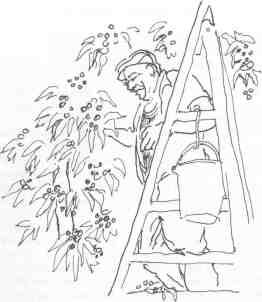
We knew that organized picking had begun the morning we heard a radio playing somewhere between the house and the road. The dogs went to investigate, bristling and noisy with self-importance, and I followed, expecting to find a gang of swarthy strangers and their larcenous children. The leaves on the trees hid their bodies from the waist upward. All I could see were various pairs of legs balanced on triangular wooden ladders, and then a great brown moon of a face under a straw trilby poked through the foliage.
The orchards were well stocked with pickers of all shapes and sizes during the next few days, and I stopped to give two of them a ride into Bonnieux one evening. They were students from Australia, red from the sun and stained with cherry juice. They were exhausted, and complained about the hours and the tedium and the stinginess of the French peasant.
"Well, at least you're seeing a bit of France."
" France?" said one of them. "All I've seen is the inside of a flaming cherry tree."
They were determined to go back to Australia with no good memories of their time in Provence. They didn't like the people. They were suspicious of the food. French beer gave them the runs. Even the scenery was small by Australian standards. They couldn't believe I had chosen to live here. I tried to explain, but we were talking about two different countries. I dropped them off at the café, where they would spend the evening being homesick. They were the only miserable Australians I had ever met, and it was depressing to hear a place that I loved being so thoroughly condemned.
Bernard cheered me up. I had come to his office in Bonnieux with the translation of a letter that he had received from an English client, and he was laughing as he opened the door.
His friend Christian, who was also our architect, had just been asked to redesign a brothel in Cavaillon. There were,
Unfortunately, said Bernard, although Christian regarded it as an interesting architectural challenge, he was going to turn it down. Madame who ran the enterprise wanted the work finished in an impossibly short time, and she wasn't prepared to close the premises while it was being done, which would place severe demands on the workmen's powers of concentration. Nor was she prepared to pay the TVA, arguing that she didn't charge her clients a sales tax, so why should she have to pay one? In the end, she would hire a couple of renegade masons who would do a fast and clumsy job, and the chance of getting Cavaillon's brothel photographed for the pages of the
WE WERE LEARNING what it was like to live more or less permanently with guests. The advance guard had arrived at Easter, and others were booked in until the end of October. Half-forgotten invitations, made in the distant safety of winter, were coming home to roost and drink and sunbathe. The girl in the laundry assumed from our sheet count that we were in the hotel business, and we remembered the warnings of more experienced residents.
As it turned out, the early visitors must have taken a course in being ideal guests. They rented a car, so that they weren't dependent on us to ferry them around. They amused themselves during the day, and we had dinner together in the evening. They left when they had said they were going to. If they were all like that, we thought, the summer would pass very pleasantly.
The greatest problem, as we soon came to realize, was that our guests were on holiday. We weren't. We got up at seven. They were often in bed until ten or eleven, sometimes finishing breakfast just in time for a swim before lunch. We worked while they sunbathed. Refreshed by an afternoon nap, they came to life in the evening, getting into high social gear as we were falling asleep in the salad. My wife, who has a congenitally hospitable nature and a horror of seeing people underfed, spent hours in the kitchen, and we washed dishes far into the night.
Sundays were different. Everybody who came to stay with us wanted to go to one of the Sunday markets, and they start early. For once in the week, we and the guests kept the same hours. Bleary-eyed and unusually quiet, they would doze in the back of the car during the twenty-minute ride to breakfast in the café overlooking the river at Isle-sur-la-Sorgue.
We parked by the bridge and woke our friends. They had gone to bed, reluctant and still boisterous, at two in the morning, and the bright light was having savage effects on their hangovers. They hid behind sunglasses and nursed big cups of
We set off for the main square, running the gauntlet between groups of sallow gypsy girls in tight, shiny black skirts selling lemons and long plaits of garlic, hissing at one another in competition. The stalls were crammed haphazardly along the street-silver jewelery next to flat wedges of salt cod, wooden barrels of gleaming olives, hand-woven baskets, cinnamon and saffron and vanilla, cloudy bunches of gypsophila, a cardboard box full of mongrel puppies, lurid Johnny Hallyday T-shirts, salmon-pink corsets and brassières of heroic proportions, rough country bread and dark terrines.
A lanky blue-black Senegalese loped through the turmoil of the square, festooned with his stock of authentic African tribal leatherware, made in Spain, and digital watches. There was a roll of drums. A man in a flat-topped peaked hat, accompanied by a dog dressed in a red jacket, cleared his throat and adjusted his portable loudspeaker system to an unbearable whine. Another drum roll. "
Three Algerians with deeply rutted brown faces stood gossiping in the sun, their lunches hanging upside down from their hands. The live chickens they were holding by the legs had a fatalistic air about them, as if they knew that their hours were numbered. Everywhere we looked, people were eating. Stall holders held out free samples-slivers of warm pizza, pink ringlets of ham, sausage dusted with herbs and spiced with green peppercorns, tiny, nutty cubes of nougat. It was a dieter's vision of hell. Our friends started asking about lunch.
We were hours away from lunch, and before that we had to see the nonedible side of the market, the
Faded sepia postcards and old linen smocks were jumbled up with fistfuls of cutlery, chipped enamel signs advertising purgatives and pomade for unruly mustaches, fire irons and chamber pots, Art Deco brooches and café ashtrays, yellowing books of poetry and the inevitable Louis Quatorze chair, perfect except for a missing leg. As it got closer to noon the prices went down and haggling began in earnest. This was the moment for my wife, who is close to professional standard at haggling, to strike. She had been circling a small plaster bust of Delacroix. The dealer marked it down to seventy-five francs, and she moved in for the kill.
"What's your best price?" she asked the dealer.
"My
We put Delacroix in the car, where he gazed thoughtfully out of the back window, and we joined the rest of France as the entire country prepared itself for the pleasures of the table.
One of the characteristics which we liked and even admired about the French is their willingness to support good cooking, no matter how remote the kitchen may be. The quality of the food is more important than convenience, and they will happily drive for an hour or more, salivating en route, in order to eat well. This makes it possible for a gifted cook to prosper in what might appear to be the most unpromising of locations, and the restaurant we had chosen was so isolated that on our first visit we'd taken a map.
Buoux is barely large enough to be called a village. Hidden in the hills about ten miles from Bonnieux, it has an ancient Mairie, a modern telephone kiosk, fifteen or twenty scattered houses, and the Auberge de la Loube, built into the side of the hill with an empty, beautiful valley below it. We had found it with some difficulty in the winter, doubting the map as we went deeper and deeper into the wilderness. We had been the only clients that night, eating in front of a huge log fire while the wind rattled the shutters.
There could hardly have been a greater contrast between that raw night and a hot Sunday in May. As we came around the bend in the road leading to the restaurant we saw that the small parking area was already full, half of it taken up by three horses tethered to the bumper of a decrepit Citroen. The restaurant cat sprawled on the warm roof tiles, looking speculatively at some chickens in the next field. Tables and chairs were arranged along the length of an open-fronted barn, and we could hear the ice buckets being filled in the kitchen.
Maurice the chef came out with four glasses of peach champagne, and took us over to see his latest investment. It was an old open carriage with wooden wheels and cracked leather seats, large enough for half a dozen passengers. Maurice was planning to organize horse-drawn coach excursions through the Lubéron, stopping,
He had taught himself to cook, but he had no desire to become the Bocuse of Buoux. All he wanted was enough business to allow him to stay in his valley with his horses. The success of his restaurant was based on value for money and good, simple food rather than flights of gastronomic fancy, which he called
There was one menu, at 110 francs. The young girl who serves on Sundays brought out a flat basketwork tray and put it in the middle of the table. We counted fourteen separate hors d'oeuvres-artichoke hearts, tiny sardines fried in batter, perfumed
The other customers were all French, people from the neighboring villages dressed in their clean, somber Sunday clothes, and one or two more sophisticated couples looking fashionably out of place in their bright boutique colors. At a big table in the corner, three generations of a family piled their plates high and wished each other
The main course arrived-rosy slices of lamb cooked with whole cloves of garlic, young green beans, and a golden potato-and-onion
The cheese was from Banon, moist in its wrapping of vine leaves, and then came the triple flavors and textures of the desserts-lemon sorbet, chocolate tart, and
Maurice came over and asked if his cooking had pleased us. He sat down while he did some addition on a scrap of paper.
On the way home, we noticed that the combination of food and Sunday has a calming influence on the French motorist. His stomach is full. He is on his weekly holiday. He dawdles along without being tempted by the thrills of overtaking on a blind bend. He stops to take the air and relieve himself in the bushes by the roadside, at one with nature, nodding companionably at passing cars. Tomorrow he will take up the mantle of the kamikaze pilot once again, but today it is Sunday in Provence, and life is to be enjoyed.
(support [a t] reallib.org)