"The Closers" - читать интересную книгу автора (Connelly Michael)
2
BOSCH RODE THE ELEVATOR just one flight down to five. This, too, was new territory for him. Five had always been a civilian floor. It primarily housed many of the department’s mid- and low-level administrative offices, most of them filled with nonsworn employees, budgeters, analysts, pencil pushers. Civilians. Before now there had been no reason to come to the fifth.
There were no placards in the elevator lobby that pointed the way to specific offices. It was the kind of floor where you knew where you were going before you stepped off the elevator. But not Bosch. The hallways on the floor formed the letter H and he went the wrong way twice before finally finding the door marked 503. There was nothing else on the door. He paused before opening it and thought about what he was doing and what he was starting. He knew it was the right thing. It was almost as if he could hear the voices coming through the door. All eight thousand of them.
Kiz Rider was sitting on a desk just inside, sipping a cup of steaming coffee. The desk looked like a place for a receptionist but Bosch knew from his frequent calls in the prior weeks that there was no receptionist in this squad. There was no money for such a luxury. Rider raised her wrist and shook her head as she checked her watch.
“I thought we agreed on eight o’clock,” she said. “Is that how it’s going to be, partner? You waltzing in every morning whenever you feel like it?”
Bosch looked at his watch. It was five minutes after eight. He looked back at her and smiled. Rider smiled and said, “We’re over here.”
Rider was a short woman who carried a few extra pounds. Her hair was short and now had some gray in it. She was very dark complected, which made her smile all the more brilliant. She slipped off the desk, and from behind where she had perched she raised a second cup of coffee to him.
“See if I remembered that right.”
He checked and nodded.
“Black, just like I like my partners.”
“Funny. I’ll have to write you up for that.”
She led the way. The office seemed to be empty. It was large, even for a squad room serving nine investigators-four teams and an OIC. The walls were painted a light shade of blue, like Bosch often saw on the screens of computers. It was carpeted in gray. There were no windows. At the positions on the walls where there should have been windows there were bulletin boards or nicely framed crime scene photos from many years back. Bosch could tell that in these black and whites the photographers had often put their artistic skills ahead of their clinical duties. The shots were heavy on mood and shadows. Not many of the crime scene details were apparent.
Rider must have known he was looking at the photos.
“They told me that writer James Ellroy picked these out and had them framed for the office,” she said.
She led him around a partial wall that broke the room in two and into an alcove where two gray steel desks were pushed together so the detectives who sat at them would face each other. Rider put her coffee down on one. There were already files stacked on it and personal things like a coffee mug full of pens and a picture frame at an angle that hid the photo it held. A laptop computer was open and humming on the desk. She had moved into the squad the week before while Bosch was still clearing customs-customs being the medical exam and final paperwork that brought him back onto the job.
The other desk was clean, empty and waiting for him. He moved behind it and put his coffee down. He suppressed a smile as well as he could.
“Welcome back, Roy,” Rider said.
That made the smile break through. It made Bosch feel good to be called Roy again. It was a tradition carried by many of the city’s homicide detectives. There was a legendary homicide man named Russell Kuster who had worked out of Hollywood Division many years back. He was the ultimate professional, and many of the detectives working murders in the city today had come under his tutelage at one point or another. He was killed in an off-duty shootout in 1990. But his habit of calling people Roy-no matter their real name-was carried on. Its origin had become obscure. Some said it was because Kuster once had a partner who loved Roy Acuff and it had started with him. Others said it was because Kuster liked the idea of the homicide cop being the Roy Rogers type, wearing the white hat and riding to the rescue, making things right. It didn’t matter anymore. Bosch knew it was an honor just to be called Roy again.
He sat down. The chair was old and lumpy, guaranteed to give him a backache if he spent too much time in it. But he hoped that would not be the case. In his first run as a homicide detective he had lived by the adage
“Where is everybody?” he asked.
“Having breakfast. I forgot. They told me last week that the routine is that on Monday mornings everybody meets early for breakfast. They usually go over to the Pacific. I didn’t remember until I got in here this morning and found the place dead, but they should be back here soon.”
Bosch knew the Pacific Dining Car was a longtime favorite with LAPD brass and the Robbery-Homicide Division. He also knew something else.
“Twelve bucks for a plate of eggs. I guess that means this is an overtime-approved squad.”
Rider smiled in confirmation.
“You got that right. But you wouldn’t have been able to finish your fancy eggs anyway, once you got the forthwith from the chief.”
“You heard about that, huh?”
“I still have an ear out on six. Did you get your badge?”
“Yeah, he gave it to me.”
“I told him what number you’d want. Did you get it?”
“Yeah, Kiz, thanks. Thanks for everything.”
“You already told me that, partner. You don’t need to keep saying that.”
He nodded and looked around their space. He noticed that on the wall behind Rider was a photo of two detectives huddled beside a body lying in the dry concrete bed of the Los Angeles River. It looked like a shot from the early fifties, judging by the hats the detectives wore.
“So, where do we start?” he asked.
“The squad breaks the cases up in three-year increments. It provides some continuity. They say you get to know the era and some of the players in the department. It overlaps. It also helps with identifying serials. In two years they’ve already come up with four serials nobody ever knew about.”
Bosch nodded. He was impressed.
“What years did we get?” he asked.
“Each team has four or five blocks. Since we’re the new team we got four.”
She opened the middle drawer of her desk, took out a piece of paper and handed it across to him.
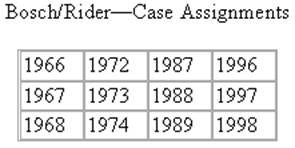 |
Bosch studied the listing of years for which they would be responsible. He had been out of the city and in Vietnam for most of the first block.
“The summer of love,” he said. “I missed it. Maybe that’s what’s wrong with me.”
He said it just to be saying something. He noticed that the second block included 1972, the year he had come onto the force. He remembered a call out to a house off of Vermont on his second day on the job in patrol. A woman back east asked police to check on her mother, who was not answering the phone. Bosch found her drowned in a bathtub, her hands and feet bound with dog leashes. Her dead dog was in the tub with her. Bosch wondered if the old woman’s murder was one of the open cases he would now be charged with solving.
“How was this arrived at? I mean, why did we get these years?”
“They came from the other teams. We lightened their caseload. In fact, they already started the ball rolling on cases from a lot of those years. And I heard on Friday that a cold hit came in from ’eighty-eight. We’re supposed to run with it starting today. I guess you could say it’s your welcome-back present.”
“What’s a cold hit?”
“When a DNA stamp or a latent we send through the computers or the DOJ makes a blind match.”
“What’s ours?”
“I think it’s a DNA match. We’ll find out this morning.”
“They didn’t tell you anything last week? I could have come in over the weekend, you know.”
“I know that, Harry. But this is an old case. There was no need to start running the minute a piece of paper came in the mail. Working Open-Unsolved is different.”
“Yeah? How come?”
Rider looked exasperated, but before she could answer they heard the door open and the squad room started filling with voices. Rider stepped out of the alcove and Bosch followed. She introduced Bosch to the other members of the squad. Two of the detectives, Tim Marcia and Rick Jackson, Bosch knew well from previous cases. The other two pairs of partners were Robert Renner and Victor Robleto, and Kevin Robinson and Jean Nord. Bosch knew them, as well as Abel Pratt, the officer in charge of the unit, by reputation. Every one of them was a top-notch homicide investigator.
The greeting was cordial and subdued, a bit overly formal. Bosch knew that his posting in the unit was probably viewed with suspicion. An assignment on the squad would have been highly coveted by detectives throughout the department. The fact that he had gotten the posting after nearly three years in retirement raised questions. Bosch knew, as the chief of police had reminded him, that he had Rider to thank for the job. Her last posting had been in the chief’s office as a policy analyst. She had cashed in whatever markers she had accrued with the chief in order to get Bosch back inside the department and working open-unsolved cases with her.
After all the handshakes, Pratt invited Bosch and Rider back into his office for a private welcome-aboard speech. He sat behind his desk and they took the side-by-side chairs in front of it. There was no room in the closet-sized space for other furnishings.
Pratt was a few years younger than Bosch, on the south side of fifty. He kept himself in shape and carried the esprit de corps of the vaunted Robbery-Homicide Division, of which the Open-Unsolved Unit was just one branch. Pratt appeared confident in his skills and his command of the unit. He had to be. The RHD took on the city’s most difficult cases. Bosch knew that if you did not believe you were smarter, tougher and more cunning than the people you were after then you didn’t belong.
“What I really should do is split you two up,” he began. “Make you work with guys already established here in the unit because this is different from what you’ve done in the past. But I got the word from six and I don’t mess with that. Besides, I understand you two have a prior chemistry that worked. So forget what I should do and let me tell you a little bit about working open-unsolveds. Kiz, I know you already got this speech last week but you’ll just have to suffer along, okay?”
“Of course,” Rider said.
“First of all, forget closure. Closure is bullshit. Closure is a media term, something they put in newspaper articles about cold cases. Closure is a joke. It’s a fucking lie. All we do here is provide answers. Answers have to be enough. So don’t mislead yourself about what you are doing here. Don’t mislead the family members you deal with on these cases and don’t be misled by them.”
He paused for reaction, got none and moved on. Bosch noticed that the crime scene photo framed on the wall was of a man collapsed in a bullet-riddled phone booth. It was the kind of phone booth you only saw in old movies and at the Farmers Market or over at Phillippe’s.
“Without a doubt,” Pratt said, “this squad is the most noble place in the building. A city that forgets its murder victims is a city lost. This is where we don’t forget. We’re like the guys they bring in in the bottom of the ninth inning to win or lose the game. The closers. If we can’t do it, nobody can. If we blow it, the game is over because we’re the last resort. Yes, we’re outnumbered. We’ve got eight thousand open-unsolveds since nineteen sixty. But we are undaunted. Even if this whole unit clears only one case a month-just twelve a year-we are doing something. We’re the closers, baby. If you’re in homicide, this is the place to be.”
Bosch was impressed by his fervor. He could see sincerity and even pain in his eyes. He nodded. He immediately knew that he wanted to work for this man, a rarity in his experience in the department.
“Just don’t forget that closure isn’t the same as being a closer,” Pratt added.
“Got it,” Bosch said.
“Now, I know you both have long experience working homicides. What you are going to find different here is your relationship with the cases.”
“Relationship?” Bosch asked.
“Yes, relationship. What I mean is that working fresh kills is a completely different animal. You have the body, you have the autopsy, you carry the news to the family. Here you are dealing with victims long dead. There are no autopsies, no physical crime scenes. You deal with the murder books-if you can find them-and the records. When you go to the family-and believe me you don’t go until you are good and ready-you find people who have already suffered the shock and found or not found ways to get past it. It wears on you. I hope you are prepared for that.”
“Thanks for the warning,” Bosch said.
“With fresh kills it is clinical because things move fast. With old cases it is emotional. You are going to see the toll of violence over time. Be prepared for it.”
Pratt pulled a thick blue binder from the side of his desk to the center of his calendar blotter. He started to push it across to them then stopped.
“Another thing to be prepared for is the department. Count on files being incomplete or even missing. Count on physical evidence being destroyed or disappeared. Count on starting from scratch with some of these. This unit was put together two years ago. We spent the first eight months just going through the case logs and pulling out open-unsolveds. We fed what we could into the forensics pipelines, but even when we’ve gotten a hit we have been handicapped by the lack of case integrity. It has been abysmal. It has been frustrating. Even though there is no statute of limitations on murder we are finding that evidence and even files were routinely disposed of during at least one administration.
“What I am saying is that you are going to find that your biggest obstacle on some of these cases may very well be the department itself.”
“Somebody said we have a cold hit that came out of one of our time blocks,” Bosch said.
He’d heard enough. He just wanted to get moving on something.
“Yes, you do,” Pratt said. “We’ll get to that in a second. Let me just finish up with my little speech. After all, I don’t get to make it that often. In a nutshell, what we try to do here is apply new technology and techniques to old cases. The technology is essentially threefold. You have DNA, fingerprints, and ballistics. In all three areas the advancements in comparative analysis have been phenomenal in the last ten years. The problem with this department is that it never took any of these advances and looked backward at old cases. Consequently, we have an estimated two thousand cases in which there is DNA evidence that has never been typed and compared. Since nineteen sixty we have four thousand cases with fingerprints that have never been run through a computer. Ours, the FBI’s, DOJ’s, anybody’s computer. It’s almost laughable but it’s too fucking sad to laugh about. Same with ballistics. We are finding the evidence is still there in most of these cases but it has been ignored.”
Bosch shook his head, already feeling the frustration of all the families of the victims, the cases swept away by time, indifference and incompetence.
“You will also find that techniques are different. Today’s homicide copper is just plain better than one from, say, nineteen sixty or seventy. Even nineteen eighty. So even before you get to the physical evidence and you review these cases you are going to see things that seem obvious to you now, but that weren’t obvious to anyone back at the time of the kill.”
Pratt nodded. His speech was finished.
“Now, the cold hit,” he said, pushing the faded blue murder book across the desk. “Run with that baby. It’s all yours. Close it down and put somebody in jail.”
(support [a t] reallib.org)