"A Year In Provence" - читать интересную книгу автора (Mayle Peter)
September
 |
OVERNIGHT, the population of the Lubéron dwindled. The
We began to see our local friends again as they emerged from the summer siege. Most of them were recovering from a surfeit of guests, and there was a certain awful similarity in the stories they told. Plumbing and money were the main topics, and it was astonishing how often the same phrases were used by mystified, apologetic, or tightfisted visitors. Unwittingly, they had compiled between them The Sayings of August.
"What do you mean, they don't take credit cards? Everyone takes credit cards."
"You've run out of vodka."
"There's a very peculiar smell in the bathroom."
"Do you think you could take care of this? I've only got a five hundred-franc note."
"Don't worry. I'll send you a replacement as soon as I get back to London."
"I didn't realize you had to be so careful with a septic tank."
"Don't forget to let me know how much those calls to Los Angeles were."
"I feel terrible watching you slave away like that."
"You've run out of whisky."
As we listened to the tales of blocked drains and guzzled brandy, of broken wineglasses in the swimming pool, of sealed wallets and prodigious appetites, we felt that we had been very kindly treated during August. Our house had suffered considerable damage, but from the sound of it our friends' houses had suffered too. At least we hadn't had to provide food and lodging for Menicucci while he was wreaking havoc.
In many ways, the early part of September felt like a second spring. The days were dry and hot, the nights cool, the air wonderfully clear after the muggy haze of August. The inhabitants of the valley had shaken off their torpor and were getting down to the main business of the year, patrolling their vineyards every morning to examine the grapes that hung for mile after mile in juicy and orderly lines.
Faustin was out there with the rest of them, cupping the bunches in his hand and looking up at the sky, sucking his teeth in contemplation as he tried to second-guess the weather. I asked him when he thought he was going to pick.
"They should cook some more," he said. "But the weather in September is not to be trusted."
He had made the same gloomy comment about the weather every month of the year so far, in the resigned and plaintive tones used by farmers all over the world when they tell you how hard it is to scratch a living from the land. Conditions are never right. The rain, the wind, the sunshine, the weeds, the insects, the government-there is always at least one fly in their ointment, and they take a perverse pleasure in their pessimism.
"You can do everything right for eleven months a year," said Faustin, "and then-
As if his life were not already filled with grief, Nature had put a further difficulty in his way: the grapes on our land would have to be picked at two separate times, because about five hundred of our vines produced table grapes which would be ready before the
To make up for the mournful predictions of Faustin, we received a daily ration of joyful news from Menicucci, now coming to the end of his labors on the central heating system and almost beside himself with anticipation as the day of firing up the boiler approached. Three times he reminded me to order the oil, and then insisted on supervising the filling of the tank to make sure that the delivery was free from foreign bodies.
The fuel man drew himself up in outrage, parrying Menicucci's wagging finger with his own, oily and black-rimmed at the tip. "My fuel is already triple-filtered.
"We shall see," said Menicucci. "We shall see." He looked with suspicion at the nozzle before it was placed inside the tank, and the fuel man wiped it ostentatiously on a filthy rag. The filling ceremony was accompanied by a detailed technical discourse on the inner workings of the burner and the boiler which the fuel man listened to with scant interest, grunting or saying
We gathered in what had once been a dormitory for donkeys, now transformed by Menicucci into the nerve center of his heating complex. Boiler, burner, and water tank were arranged side by side, joined together by umbilical cords of copper, and an impressive array of painted pipes-red for hot water, blue for cold,
Menicucci took it as a personal criticism, and spent ten minutes demonstrating its astonishing simplicity, flicking switches, opening and closing valves, twiddling dials and gauges, and making me thoroughly bewildered.
The beast awoke with a series of clicks and snuffles.
He scuttled around the house, insisting that we touch each radiator. "You see? You will be able to pass the entire winter
"
THERE IS ONE September weekend when the countryside sounds as though rehearsals are being held for World War Three. It is the official start of the hunting season, and every red-blooded Frenchman takes his gun, his dog, and his murderous inclinations into the hills in search of sport. The first sign that this was about to happen came through the post-a terrifying document from a gunsmith in Vaison-la-Romaine, offering a complete range of artillery at preseason prices. There were sixty or seventy models to choose from, and my hunting instincts, which had been dormant since birth, were aroused by the thought of owning a Verney Carron Grand Bécassier, or a Ruger.44 Magnum with an electronic sight. My wife, who has a well-founded lack of confidence in my ability to handle any kind of dangerous equipment, pointed out that I hardly needed an electronic sight to shoot myself in the foot.
We had both been surprised at the French fondness for guns. Twice we had visited the homes of outwardly mild and unwarlike men, and twice we had been shown the family arsenal; one man had five rifles of various calibers, the other had eight, oiled and polished and displayed in a rack on the dining room wall like a lethal piece of art. How could anyone need eight guns? How would you know which one to take with you? Or did you take them all, like a bag of golf clubs, selecting the.44 Magnum for leopard or moose and the Baby Bretton for rabbit?
After a while, we came to realize that the gun mania was only part of a national fascination with outfits and accoutrements, a passion for looking like an expert. When a Frenchman takes up cycling or tennis or skiing, the last thing he wants is for the world to mistake him for the novice that he is, and so he accessorizes himself up to professional standard. It's instant. A few thousand francs and there you are, indistinguishable from any other seasoned ace competing in the Tour de France or Wimbledon or the Winter Olympics. In the case of
We were treated to a preview of hunting fashions in Cavaillon market. The stalls had stocked up for the season, and looked like small paramilitary depots: there were cartridge bandoliers and plaited leather rifle slings; jerkins with myriad zippered pockets and game pouches that were washable and therefore
Every hunter considers his dog to be uniquely gifted, and he will have at least one implausible story of stamina and prowess to tell you. To hear the owners talk, you would think that these dogs were supernaturally intelligent creatures, trained to a hair and faithful unto death. We looked forward with interest to seeing them perform on the opening weekend of the season. Perhaps their example would inspire our dogs to do something more useful than stalk lizards and attack old tennis balls.
Hunting in our part of the valley started shortly after seven o'clock one Sunday morning, with salvos coming from either side of the house and from the mountains behind. It sounded as though anything that moved would be at risk, and when I went out for a walk with the dogs I took the biggest white handkerchief I could find in case I needed to surrender. With infinite caution, we set off along the footpath that runs behind the house toward the village, assuming that any hunter worth his gun license would have moved well away from the beaten track and into the tangled undergrowth farther up the mountain.
There was a noticeable absence of birdsong; all sensible or experienced birds had left at the sound of the first shot for somewhere safer, like North Africa or central Avignon. In the bad old days, hunters used to hang caged birds in the trees to lure other birds close enough for a point-blank shot, but that had been made illegal, and the modern hunter now had to rely on woodcraft and stealth.
I didn't see much evidence of that, but I did see enough hunters and dogs and weaponry to wipe out the entire thrush and rabbit population of southern France. They hadn't gone up into the forest; in fact, they had barely left the footpath. Knots of them were gathered in the clearings-laughing, smoking, taking nips from their khaki-painted flasks and cutting slices of
Their dogs, however, were anxious to get to work. After months of confinement in kennels, they were delirious with liberty and the scents of the forest, tracking back and forth, noses close to the ground and twitching with excitement. Each dog wore a thick collar with a small brass bell-the
Another benefit of the
Just before noon, camouflage-clad figures started to make their way to the vans parked at the side of the road. A few had dogs with them. The rest were whistling and shouting with increasing irritation, making a bad-tempered hissing noise-
Response was patchy. The shouts became more bad tempered, degenerating into bellows and curses. After a few minutes the hunters gave up and went home, most of them dogless.
We were joined a little later for lunch by three abandoned hounds who came down to drink at the swimming pool. They were greatly admired by our two bitches for their devil-may-care manner and exotic aroma, and we penned them all in the courtyard while we wondered how we could get them back to their owners. We consulted Faustin.
"Don't bother," he said. "Let them go. The hunters will be back in the evening. If they don't find their dogs, they'll leave a
It always worked, so Faustin said. If the dog was in the forest, one simply left something with the scent of the kennel on it-a cushion or, more likely, a scrap of sacking-near the spot where the dog had last been seen. Sooner or later, the dog would come back to its own scent and wait to be picked up.
We let the three hounds out, and they loped off, baying with excitement. It was an extraordinary, doleful sound, not a bark or a howl but a lament, like an oboe in pain. Faustin shook his head. "They'll be gone for days." He himself didn't hunt, and regarded hunters and their dogs as intruders who had no right to be nosing around his precious vines.
He had decided, he told us, that the moment had come to pick the table grapes. They would start as soon as Henriette had finished servicing the
Henriette's ministrations were successful, and the old truck gasped up the drive early one morning, loaded with shallow wooden grape trays, just deep enough for a single layer of bunches. Stacks of trays were placed along each line of vines, and the three of them-Faustin, Henriette, and their daughter-took their scissors and set to work.
It was a slow and physically uncomfortable business. Because the appearance of table grapes is almost as important as their taste, every bunch had to be examined, every bruised or wrinkled grape snipped off. The bunches grew low, sometimes touching the earth and hidden by leaves, and the pickers' progress was in yards per hour-squatting down, cutting, standing up, inspecting, snipping, packing. The heat was fierce, coming up from the ground as well as beating down on the necks and shoulders. No shade, no breeze, no relief in the course of a ten-hour day except the break for lunch. Never again would I look at a bunch of grapes in a bowl without thinking of backache and sunstroke. It was past seven when they came in for a drink, exhausted and radiating heat, but satisfied. The grapes were good and three or four days would see them all picked. I said to Faustin that he must be pleased with the weather. He pushed back his hat and I could see the line sharp across his forehead where the burned brown skin turned white.
"It's too good," he said. "It won't last." He took a long pull at his pastis as he considered the spectrum of misfortunes that could occur. If not storms, there might be a freak frost, a plague of locusts, a forest fire, a nuclear attack. Something was bound to go wrong before the second batch of grapes was picked. And, if it didn't, he could console himself with the fact that his doctor had put him on a diet to reduce his cholesterol level. Yes, that was certainly a grave problem. Reassured at having remembered that fate had recently dealt him a black card, he had another drink.
IT HAD taken me some time to get used to having a separate purpose-built room devoted exclusively to wine-not a glorified cupboard or a cramped cavity under the stairs, but a genuine
After a while, I bypassed the villages and started to follow the signs, often half-hidden by vegetation, that pointed deep into the countryside where the wines baked in the sun, and where I could buy directly from the men who made the wine. They were, without exception, hospitable and proud of their work and, to me at least, their sales pitch was irresistible.
It was early afternoon when I turned off the main road leading out of Vacqueyras and followed the narrow, stony track through the vines. I had been told that it would lead me to the maker of the wine I had liked at lunchtime, a white Côtes-du-Rhone. A case or two would fill the void in the
The track led to a sprawl of buildings, arranged in a square U around a courtyard of beaten earth, shaded by a giant plant tree and guarded by a drowsy Alsatian who welcomed me with a halfhearted bark, doing his duty as a substitute for a doorbell. A man in overalls, holding an oily collection of spark plugs, came over from his tractor. He gave me his forearm to shake.
I wanted some white wine? Of course. He himself was busy nursing his tractor, but his uncle would take care of me.
The curtain of wooden beads hanging across the front door parted, and Uncle Edward came blinking into the sunshine. He was wearing a sleeveless vest, cotton
He beamed, the lines on his cheeks looking like purple whiskers.
Uncle Edward turned on the light and closed the doors against the heat. A long trestle table and half a dozen chairs were placed under the single light bulb with its flat tin shade. In a dark corner, I could make out a flight of stairs and a concrete ramp leading down into the cellar. Crates of wine were stacked on wooden pallets around the walls, and an old refrigerator hummed quietly next to a cracked sink.
Uncle Edward was polishing glasses, holding each one up to the light before placing it on the table. He made a neat line of seven glasses, and began to arrange a variety of bottles behind them. Each bottle was accorded a few admiring comments: "The white monsieur knows, yes? A very agreeable young wine. The rosé, not at all like those thin rosés one finds on the Côte d'Azur. Thirteen degrees of alcohol, a proper wine. There's a light red-one could drink a bottle of that before a game of tennis. That one,
I tried to stop him. I told him that all I wanted were two cases of the white, but he wouldn't hear of it. Monsieur had taken the trouble to come personally, and it would be unthinkable not to taste a selection. Why, said Uncle Edward, he himself would join me in a progress through the vintages. He clapped a heavy hand on my shoulder and sat me down.
It was fascinating. He told me the precise part of the vineyard that each of the wines had come from, and why certain slopes produced lighter or heavier wines. Each wine we tasted was accompanied by an imaginary menu, described with much lip smacking and raising of the eyes to gastronomic heaven. We mentally consumed
"There is one more you should try," said Uncle Edward, "although it is not to everybody's taste." He picked up a bottle and poured a careful half glass. It was deep red, almost black. "A wine of great character," he said. "Wait. It needs
Uncle Edward helped me load the cases into the car. Had I really ordered all this? I must have. We had been sitting in the convivial murk for nearly two hours, and one can make all kinds of expansive decisions in two hours. I left with a throbbing head and an invitation to come back next month for the
Our own
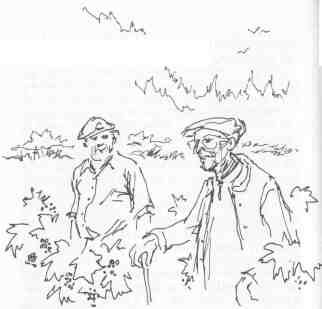
The original party of three that had picked the table grapes was reinforced by Cousin Raoul and Faustin's father. His contribution was to walk slowly behind the pickers, prodding among the vines with his stick until he found a bunch of grapes that had been overlooked and then shouting-he had a good, carrying bellow for a man of eighty-four-for someone to come back and do the job properly. In contrast to the others in their shorts and vests, he was dressed for a brisk November day in a sweater, a cap, and a suit of heavy cotton. When my wife appeared with a camera, he took off his cap, smoothed his hair, put his cap back on and struck a pose, waist deep in vines. Like all our neighbors, he loved having his portrait taken.
Slowly and noisily, the rows were picked clean, the grapes piled into plastic crates and stacked in the back of the truck. Every evening now, the roads were busy with vans and tractors towing their purple mountains to the wine cooperative at Maubec, where they were weighed and tested for alcoholic content.
To Faustin's surprise, the crop was gathered without incident, and to celebrate he invited us to go with him to the cooperative when he made the last delivery. "Tonight we will see the final figures," he said, "and then you will know how much you can drink next year."
We followed the truck as it swayed off into the sunset at twenty miles an hour, keeping to narrow roads that were stained with fallen, squashed grapes. There was a queue waiting to unload. Burly men with roasted faces sat on their tractors until it was their turn to back up to the platform and tip their loads down the chute-the first stage of their journey to the bottle.
Faustin finished unloading, and we went with him into the building to see our grapes going into the huge stainless-steel vats. "Watch that dial," he said. "It shows the degrees of alcohol." The needle swung up, quivered, and settled at 12.32 percent. Faustin grunted. He would have liked 12.50 and an extra few days in the sun might have done it, but anything above 12 was reasonable. He took us over to the man who kept the tallies of each delivery and peered at a line of figures on a clipboard, matching them with a handful of slips of paper he pulled from his pocket. He nodded. It was all correct.
"You won't go thirsty." He made the Provençal drinking gesture, fist clenched and thumb pointing towards his mouth. "Just over one thousand two hundred liters."
It sounded like a good year to us, and we told Faustin we were pleased. "Well," he said, "at least it didn't rain."
(support [a t] reallib.org)