"A Year In Provence" - читать интересную книгу автора (Mayle Peter)
August
 |
"THERE IS a strong rumor," said Menicucci, "that Brigitte Bardot has bought a house in Roussillon." He put his spanner down on the wall and moved closer so that there was no chance of
"She intends to leave Saint-Tropez." Menicucci's finger was poised to tap me on the chest. "And I don't blame her. Do you know"-tap, tap, tap went the finger-"that at any given moment during any day in the month of August there are five thousand people making
He shook his head at the unsanitary horror of it all. "Who would be a fish?"
We stood in the sun sympathizing with the plight of any marine life unfortunate enough to be resident in Saint-Tropez while
It was the opening day of
Menicucci took me on a guided tour of the components, emphasizing their quality.
They and millions more had come down from the north in the course of a single massively constipated weekend. Twenty-mile traffic jams had been reported on the autoroute at Beaune, and anyone getting through the tunnel at Lyon in less than an hour was considered lucky. Cars and tempers became overheated. The breakdown trucks had their best weekend of the year. Fatigue and impatience were followed by accidents and death. It was a traditionally awful start to the month, and the ordeal would be repeated four weeks later in the opposite direction during the exodus weekend.
Most of the invaders passed us by on their way to the coast, but there were thousands who made their way into the Lubéron, changing the character of markets and villages and giving the local inhabitants something new to philosophize about over their pastis. Café regulars found their usual places taken by foreigners, and stood by the bar grizzling over the inconveniences of the holiday season-the bakery running out of bread, the car parked outside one's front door, the strange late hours that visitors kept. It was admitted, with much nodding and sighing, that tourists brought money into the region. Nevertheless, it was generally agreed that they were a funny bunch, these natives of August.
It was impossible to miss them. They had clean shoes and indoor skins, bright new shopping baskets and spotless cars. They drifted through the streets of Lacoste and Ménerbes and Bonnieux in a sightseer's trance, looking at the people of the village as if they too were quaint rustic monuments. The beauties of nature were loudly praised every evening on the ramparts of Ménerbes, and I particularly liked the comments of an elderly English couple as they stood looking out over the valley.
"What a marvelous sunset," she said.
"Yes," replied her husband. "Most impressive for such a small village."
Even Faustin was in fine holiday humor. His work on the vines was finished for the time being, and there was nothing he could do but wait for the grapes to ripen and try out his repertoire of English jokes on us. "What is it," he asked me one morning, "that changes from the color of a dead rat to the color of a dead lobster in three hours?" His shoulders started to shake as he tried to suppress his laughter at the unbearably funny answer.
Faustin in waggish mood early in the morning was transformed into Faustin the somber by the evening. He had heard news from the Côte d'Azur, which he told to us with a terrible relish. There had been a forest fire near Grasse, and the Canadair planes had been called out. These operated like pelicans, flying out to sea and scooping up a cargo of water to drop on the flames inland. According to Faustin, one of the planes had scooped up a swimmer and dropped him into the fire, where he had been
Curiously, there was no mention of the tragedy in
It was difficult to know what to believe. Odd things were possible in August, and so we were not at all surprised when some friends who were staying in a nearby hotel told us that they had seen an eagle at midnight in their bedroom. Well, perhaps not the eagle itself, but the unmistakable and huge
Did the eagle seem to come from the wardrobe in the corner of the room? Yes, said our friends.
THE PARTY was being held in a house outside Gordes, and we had been asked to join a few friends of the hostess for dinner before the other guests arrived. It was an evening that we anticipated with mixed feelings-pleased to be invited, but far from confident about our ability to stay afloat in a torrent of dinner party French. As far as we knew, we were going to be the only English speakers there, and we hoped we wouldn't be separated from each other by too many breakneck Provençal conversations. We had been asked to arrive at what for us was the highly sophisticated hour of nine o'clock, and we drove up the hill toward Gordes with stomachs rumbling at being kept waiting so late. The parking area behind the house was full. Cars lined the road outside for fifty yards, and every other car seemed to have a Parisian 75 number plate. Our fellow guests were not going to be a few friends from the village. We began to feel we should have worn less casual clothes.
We walked inside and found ourselves in magazine country, decorated by
Our hostess saw us before we could escape. She at least was reassuringly dressed in her usual outfit of shirt and trousers.
"You found somewhere to park?" She didn't wait for an answer. "It's a little difficult in the road because of that ditch."
We said it didn't seem at all like Provence, and she shrugged. "It's August." She gave us a drink and left us to mingle with the beautiful people.
We could have been in Paris. There were no brown, weathered faces. The women were fashionably pallid, the men carefully barbered and sleek. Nobody was drinking pastis. Conversation was, by Provençal standards, whisper-quiet. Our perceptions had definitely changed. At one time, this would have seemed normal. Now it seemed subdued and smart and vaguely uncomfortable. There was no doubt about it; we had turned into bumpkins.
We gravitated toward the least chic couple we could see, who were standing detached from the crowd with their dog. All three were friendly, and we sat down together at one of the tables on the terrace. The husband, a small man with a sharp, Norman face, told us that he had bought a house in the village twenty years before for 3,000 francs, and had been coming down every summer since then, changing houses every five or six years. He had just heard that his original house was back on the market, overrestored and decorated to death and priced at a million francs. "It's madness," he said, "but people like
They had begun to take their places at the tables, carrying bottles of wine and plates of food from the buffet. The women's high heels sank into the gravel of the terrace, and there were some refined squeals of appreciation at the deliciously primitive setting-
The Mistral started, suddenly and most inconveniently, while there was still plenty of uneaten shrimp salad on the tables. Lettuce leaves and scraps of bread became airborne, plucked from plates and blown among the snowy bosoms and silk trousers, scoring the occasional direct hit on a shirt front. Tablecloths snapped and billowed like sails, tipping over candles and wineglasses. Carefully arranged coiffures and composures were ruffled. This was a little too
More people arrived. The sound of Vivaldi from the barn was replaced by a few seconds of electronic hissing, followed by the shrieks of a man undergoing heart surgery without anesthetic: Little Richard was inviting us to get down and boogie.
We were curious to see what effect the music would have on such an elegant gathering. I could imagine them nodding their heads in time to a civilized tune, or dancing in that intimate crouch the French adopt whenever they hear Charles Aznavour, but
Colored strobe lighting was flashing and blinking, synchronized with the drumbeat and bouncing off the mirrors propped against the walls. A young man, shoulders hunched and eyes half-closed against the smoke of his cigarette, stood behind the twin turntables, his fingers coaxing ever more bass and volume from the knobs on the console.
GOOD GOLLY MISS MOLLY! screamed Little Richard. The young man went into a spasm of delight, and squeezed out an extra decibel. YOU SURE LOVE TO BALL! The barn vibrated, and
Most of them didn't bother with partners. They danced with their own reflections, keeping one eye, even in the midst of ecstasy, fixed on the mirrors. The air was filled with the smell of warm and scented flesh, and the barn turned into one huge throb, seething and frenzied and difficult to cross without being spiked by elbows or lashed by a whirling necklace.
Were these the same people who had been behaving so decorously earlier in the evening, looking as though their idea of a wild time might be a second glass of champagne? They were bouncing away like amphetamine-stuffed teenagers, and they seemed set for the night. We dodged and sidestepped through the squirming mass and left them to it. We had to be up early in the morning. We had a goat race to go to.
We had first seen the poster a week before, taped to the window of a
By nine o'clock it was already too hot to wear a watch, and the terrace in front of the Café César was spilling over with customers having their breakfast of
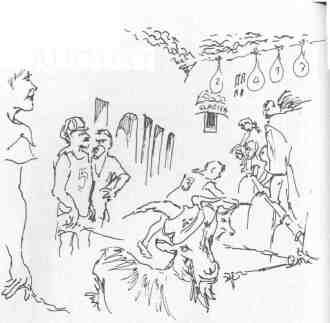
We knew they weren't far away; we could smell them and their droppings, aromatic as they cooked in the sun. We looked over the wall, and the contestants looked back at us with their mad, pale eyes, masticating slowly on some prerace treat, their chins fringed with wispy beards. They would have looked like dignified mandarins had it not been for the blue and white jockey caps that each of them was wearing, and their racing waistcoats, numbered to correspond with the list of runners. We were able to identify Bichou and Tisane and all the rest of them by name, but it was not enough to bet on. We needed inside information, or at least some help in assessing the speed and staying power of the runners. We asked the old man who was leaning on the wall next to us, confident in the knowledge that he, like every Frenchman, would be an expert.
"It's a matter of their
Most of the drivers were refreshing themselves in the café. Like the goats, they were numbered and wore jockey caps, and we were able to pick out the driver of No. 6, a brawny, likely looking man who seemed to be pacing himself sensibly with the beer. He and the recently emptied Totoche had the makings of a winning team. We went to place our bet.
"
The grand orchestra promised by the poster-a van from Apt with a sound system in the back-was broadcasting Sonny and Cher singing "I've Got You, Babe." A thin, high-chic Parisienne we recognized from the night before started to tap one dainty white-shod foot, and an unshaven man with a glass of pastis and a heavy paunch asked her to dance, swiveling his substantial hips as an inducement. The Parisienne gave him a look that could have turned butter rancid, and became suddenly interested in the contents of her Vuitton bag. Aretha Franklin took over from Sonny and Cher, and children played hopscotch among the goat droppings. The
A rope was strung across the
The drivers had now emerged from the café, and were swaggering through the crowd to collect their goats. Our favorite driver, No. 6, had his pocket knife out, and was putting a fine point on each end of his stick, which I took to be a good sign. One of the other drivers immediately lodged a complaint with the organizers, but the dispute was cut short by the arrival of a car which had somehow managed to creep down through one of the narrow streets. A young woman got out. She was holding a map. She looked extremely puzzled. She asked the way to the auto-route.
The way to the autoroute, unfortunately, was blocked by ten goats, two hundred spectators, and a musical van. Nevertheless, said the young woman, that is where I am going. She got back in the car and started inching forward.
Consternation and uproar. The organizers and some of the drivers surrounded the car, banging on the roof, brandishing sticks, rescuing goats and children from certain death beneath the barely moving wheels. Spectators surged forward to see what was going on. The car, embedded in humanity, was forced to stop, and the young woman sat looking straight ahead, tight-lipped with exasperation.
The contestants were called to the starting line, and drivers checked the fastening of the cords around the goats' necks. The goats themselves were unaffected by the drama of the occasion. No. 6 was trying to eat the waistcoat worn by No. 7. No. 9, our outsider, Nénette, insisted on facing backwards. The driver picked her up by her horns and turned her around, jamming her between his knees to keep her pointing in the right direction. Her jockey cap had been knocked over one eye, giving her a rakish and demented air, and we wondered about the wisdom of our bet. We were counting on her to take third place, but with impaired vision and no sense of geography this seemed unlikely.
They were under starter's orders. Weeks, maybe months, of training had prepared them for this moment. Horn to horn, waistcoat to waistcoat, they waited for the starting signal. One of the drivers belched loudly, and they were off.
Within fifty yards, it became apparent that these goats were not instinctive athletes, or else they had misunderstood the purpose of the event. Two of them applied their brakes firmly after a few yards, and had to be dragged along. Another remembered what it should have done half an hour before, and paused at the first bend to answer a call of nature. Nénette, possibly because she was half-blinkered by her cap, overshot the turn and pulled her driver into the crowd. The other runners straggled up the hill, stimulated by various methods of persuasion.
"Kick them up the arse!" shouted our friend with the paunch. The Parisienne, who was hemmed in next to us, winced. This encouraged him to give her the benefit of his local knowledge. "Did you know," he said, "that the last one to finish gets eaten? Roasted on a spit.
The course followed a circuit around the high part of the village, looping back down to the old fountain which had been transformed into a water obstacle with a plastic sheet stretched between some hay bales. This had to be waded or swum just before the final sprint to the line of balloons outside the café-a brutal test of coordination and stamina.
Progress reports were being shouted down by spectators at the halfway mark, and news reached us that No. 1 and No. 6 were fighting it out in the lead. Only nine goats had been counted going past; the tenth had
There was a splash from the fountain, and the sound of a woman's voice raised to scold. The water obstacle had claimed its first victim-a little girl who had miscalculated the depth, and who stood waist-deep in the water, bedraggled and bawling with surprise.
The girl's mother, in desperation at the thought of her child being trampled to a pulp by the contestants, hitched up her skirt and plunged into the water. "What thighs!" said the man with the paunch, kissing the tips of his fingers.
With a clatter of hoofs, the leading runners approached the fountain and skidded into the hay bales, showing very little enthusiasm for getting wet. Their drivers grunted and cursed and tugged and finally manhandled their goats into the water and out the other side to the finishing straight, their sodden espadrilles squelching on the tarmac, their sticks poised like lances. The positions at the halfway mark had been maintained, and it was still No. 1 and No. 6, Titine and Totoche, skittering up to the line of balloons.
No. 1, with an enormous backhand swipe, exploded his balloon first, showering the Parisienne, who stepped smartly backwards into a pile of droppings. No. 6, for all his stick sharpening before the race, had more difficulty, just managing to burst his balloon before the next runners reached the line. One by one, or in dripping groups, they staggered in until all that remained was a single swollen balloon hanging from the line. No. 9, the wayward Nénette, had not completed the course. "The butcher's got her," said the man with the paunch.
We saw her as we walked back to the car. She had broken her cord and escaped from her driver, and was perched high above the street in a tiny walled garden, her cap hanging from one horn, eating geraniums.
The team had arrived for another loud, hot day, and were exchanging greetings and handshakes with the formality of people who had never met before, addressing each other by
They were gathered around one of many holes that Menicucci had made to accommodate his central-heating pipes, and were discussing dates and schedules in the serious manner of men whose lives were governed by punctuality. There was a strict sequence to be followed: Menicucci had to complete laying his pipes; the masons were then to move in and repair the damage, followed by the electrician, the plasterer, the tile layer, the carpenter, and the painter. Since they were all good Provençaux, there was no chance at all that dates would be observed, but it provided the opportunity for some entertaining speculation.
Menicucci was enjoying his position of eminence as the key figure, the man whose progress would dictate the timetable of everyone else.
"You will see," he said, "that I have been obliged to make a Gorgonzola of the walls, but what is that,
"Maybe a day," said Didier. "But when?"
"Don't try to rush me," said Menicucci. "Forty years as a plumber have taught me that you cannot hurry central heating. It is
"Christmas?" suggested Didier.
Menicucci looked at him, shaking his head. "You joke about it, but think of the winter." He demonstrated winter for us, wrapping an imaginary overcoat around his shoulders. "It is minus ten degrees." He shivered, pulling his bonnet over his ears. "All of a sudden, the pipes start to leak! And why? Because they have been placed too quickly and without proper attention." He looked at his audience, letting them appreciate the full drama of a cold and leaking winter. "Who will be laughing then? Eh? Who will be making jokes about the plumber?"
It certainly wouldn't be me. The central heating experience so far had been a nightmare, made bearable only by the fact that we could stay outside during the day. Previous construction work had at least been confined to one part of the house, but this was everywhere. Menicucci and his copper tentacles were unavoidable. Dust and rubble and tortured fragments of piping marked his daily passage like the spoor of an iron-jawed termite. And, perhaps worst of all, there was no privacy. We were just as likely to find
The evenings were such a relief that we usually stayed at home, convalescing after the din of the day, and so we missed most of the social and cultural events that had been organized for the benefit of summer visitors to the Lubéron. Apart from a bottom-numbing evening in the Abbey of Senanque, listening to Gregorian chants as we sat on benches of appropriately monastic discomfort, and a concert held in a floodlit ruin above Oppède, we didn't move from the courtyard. It was enough just to be alone and to be quiet.
Hunger eventually forced us out one night when we discovered that what we had planned to have for dinner had acquired a thick coating of grit from the day's drilling. We decided to go to a simple restaurant in Goult, a small village with an invisible population and no tourist attractions of any kind. It would be like eating at home, but cleaner. We beat a layer of dust from our clothes and left the dogs to guard the holes in the walls.
It had been a still, oppressively hot day, and the village smelled of heat, of baked tarmac and dried-out rosemary and warm gravel. And people. We had chosen the night of the annual fête. We should have known, because every village celebrated August in one way or another-with a
At any other time of the year, the sight of more than a dozen people in the village streets would indicate an event of unusual interest-a funeral, perhaps, or a price-cutting war between the two butchers who had adjacent shops a few yards from the café. But this was an exceptional night; Goult was playing host to the world, and the world was obviously as hungry as we were. The restaurant was full. The terrace outside the restaurant was full. Hopeful couples lurked in the shadows under the trees, waiting for a free table. The waiters looked harassed. The proprietor, Patrick, looked tired but satisfied, a man with a temporary gold mine. "You should have called," he said. "Come back at ten and I'll see what I can do."
Even the café, which was large enough to hold the entire population of Goult, could offer standing room only. We took our drinks across the road, where stalls had been set up in a hollow square around the monument honoring the men of the village who had fought and died in the wars, fallen for the glory of France. Like most war memorials we had seen, it was respectfully well kept, with a cluster of three new
The windows in the houses around the square were open and the occupants leaned out, their flickering television sets forgotten behind them as they watched the slow-moving confusion below. It was more of a market than anything else, local artisans with their carved wood and pottery, wine growers and honey makers, a few antique dealers and artists. The heat of the day could be felt in the stone walls and seen in the way that the lazy, drifting crowd was walking, weight back on the heels, stomachs out, shoulders relaxed in a holiday slouch.
Most of the stands were trestle tables, with artifacts displayed on print tablecloths, often with a notice propped up saying that the owner could be found in the café if there was any risk of a sale. One stand, larger and more elaborate than the others, looked like an outdoor sitting room, furnished with tables and chairs and chaises longues and decorated with potted palms. A dark, stocky man in shorts and sandals sat at one of the tables with a bottle of wine and an order book. It was Monsieur Aude, the artist
The
He tapped his order book. "I could open a factory-Germans, Parisians, Belgians. This year they all want the big round tables and these garden chairs." He moved the chair next to him so that we could see the graceful arch of the legs. "The problem is that they think I can make everything in a couple of days, and as you know…" he left the sentence unfinished, and chewed reflectively on a mouthful of wine. A couple who had been circling the stand came up and asked about a campaign bed. Monsieur Aude opened his book and licked the point of his pencil, then looked up at them. "I have to tell you," he said with a completely straight face, "that it might take two weeks."
It was almost eleven by the time we started to eat, and well past midnight when we got home. The air was warm and heavy and abnormally still. It was a night for the pool, and we slipped into the water to float on our backs and look at the stars-the perfect end to a sweltering day. A long way off, from the direction of the Côte d'Azur, there was a mutter of thunder and the brief flicker of lightning, distant and ornamental, somebody else's storm.
It reached Ménerbes in the dark and early hours of the morning, waking us with a clap that shook the windows and startled the dogs into a chorus of barking. For an hour or more it seemed to stay directly above the house, rolling and exploding and floodlighting the vineyard. And then it rained with the intensity of a burst dam, crashing on the roof and in the courtyard, dripping down the chimney and seeping under the front door. It stopped just after dawn and, as if nothing had happened, the sun came up as usual.
We had no electricity. A little later, when we tried to call the Electricité de France office, we found we had no phone line. When we walked around the house to see what the storm had destroyed we saw that half the drive had been washed into the road, leaving ruts as wide as tractor wheels and deep enough to be dangerous to any normal car. But there were two silver linings: It was a beautiful morning, and there were no workmen. They were undoubtedly too busy with their own leaks to worry about our central heating. We went for a walk in the forest, to see what the storm had done there.
It was dramatic, not because of any uprooted trees, but because of the effects of the deluge on earth that had been baked for weeks. Wraiths of steam rose among the trees, and with them a continuous hissing sound as the heat of the new day started to dry the undergrowth. We came back for a late breakfast filled with the optimism that sunshine and blue sky can inspire, and we were rewarded by a working phone, with Monsieur Fructus on the end of it. He had called to see if his insurance policy had suffered any damage.
We told him that the only casualty had been the drive.
He was right. It had been a strange month, and we were glad it was over so that life could return to the way it had been before, with empty roads and uncrowded restaurants and Menicucci back in long trousers.
(support [a t] reallib.org)